
What Is Implied Probability?
What Is Implied Probability? Introduction Betting odds show two things at the same time: the possible payout and the probability implied by the bookmaker price. If you do.
Introduction
Betting odds show two things at the same time: the possible payout and the probability implied by the bookmaker price. If you do not understand odds, it is hard to know whether a price is fair or whether the potential return is worth the risk.
Football bettors usually see odds in decimal, fractional, or American format. The format changes how the price is displayed, but the underlying idea is the same: odds convert probability into a payout.
What Are Betting Odds?
Betting odds are the price of a betting outcome. They tell you how much you can return from a winning bet and what probability the bookmaker is broadly assigning to that outcome.
For example, decimal odds of 2.50 mean every 1 unit staked returns 2.50 units if the bet wins. That return includes the original stake.
Why Odds Matter in Football Betting
Odds matter because a good football opinion is not enough. A team can be likely to win but still be a poor bet if the odds are too short.
Understanding odds also helps you compare different markets. A home win at 1.50, over 2.5 goals at 2.10, and both teams to score at 1.85 all carry different implied probabilities and different payout profiles.
How Betting Odds Work
Decimal odds
Decimal odds are common in Europe and are the simplest format for beginners. The formula is stake multiplied by decimal odds equals total return.
If the odds are 2.50 and your stake is EUR 10, the return is EUR 25. The profit is EUR 15 because your EUR 10 stake is included in the EUR 25 return.
Fractional odds
Fractional odds show profit relative to stake. Odds of 6/4 mean you can win 6 units of profit for every 4 units staked.
Fractional odds can be converted to decimal odds by dividing the first number by the second number and adding 1. So 6/4 becomes 2.50 in decimal odds.
American odds
American odds use positive and negative numbers. Positive odds show how much profit you make from a 100-unit stake. +150 means a 100 stake wins 150 profit.
Negative odds show how much you must stake to win 100 profit. -150 means you need to stake 150 to win 100 profit.
How to Calculate Implied Probability
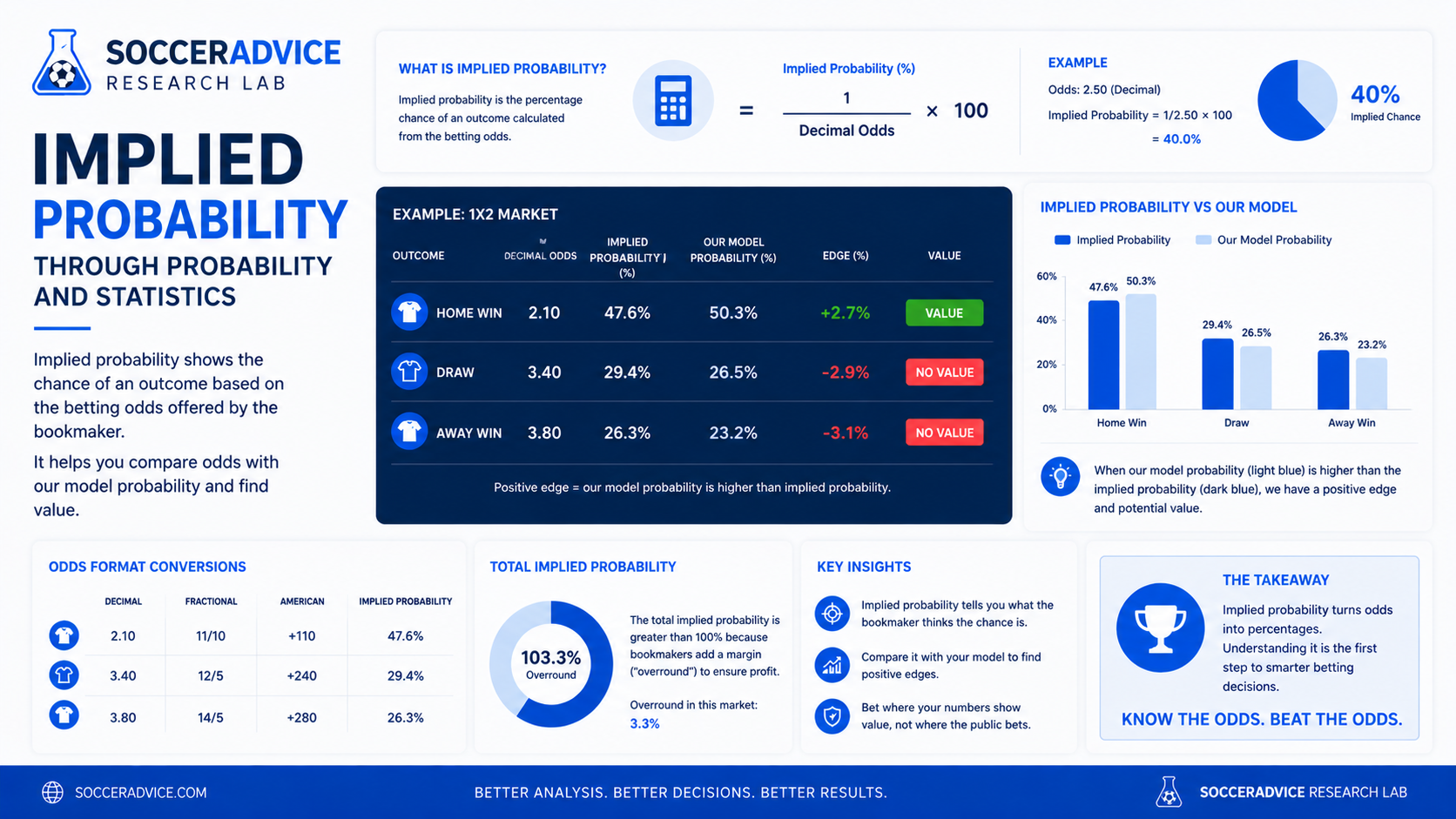
Implied probability converts odds into a percentage. For decimal odds, the formula is 1 divided by decimal odds.
At decimal odds of 2.50, the calculation is 1 / 2.50 = 0.40, or 40%. The bookmaker price is therefore implying roughly a 40% chance before margin is considered.
Bookmaker margin
Bookmakers build margin into their odds. This means the implied probabilities across all outcomes usually add up to more than 100%.
In a football 1X2 market, if the home win, draw, and away win probabilities add up to 106%, the extra 6% is part of the bookmaker overround. That margin is one reason bettors need prices that are better than their own estimated probability.
Stake, return, and profit
Return and profit are not the same. Return includes your original stake; profit is what you win above the stake. At odds of 2.50 with EUR 10 staked, return is EUR 25 and profit is EUR 15.
Betting Odds Examples
Decimal Odds: 2.50. Stake: EUR 10. Return: EUR 25. Profit: EUR 15. This is calculated as EUR 10 x 2.50 = EUR 25 total return, then EUR 25 – EUR 10 = EUR 15 profit.
Implied Probability: 1 / 2.50 = 40%. If you believe the outcome wins more often than 40% of the time, the price may be interesting. If you believe it wins less often than 40%, the odds are probably too short.
Bookmaker margin example: if Team A is 2.00, the draw is 3.40, and Team B is 3.80, the implied probabilities are 50.0%, 29.4%, and 26.3%. Together that is 105.7%, which shows margin in the market.
Common Betting Odds Mistakes
- Confusing return with profit.
- Thinking low odds automatically mean a safe bet.
- Ignoring implied probability.
- Comparing two odds prices without converting them into probability.
- Forgetting that bookmaker margin is already built into the market.
Practical Odds Takeaways
- Decimal odds show total return, not just profit.
- Implied probability for decimal odds is 1 divided by the odds.
- Odds of 2.50 imply a 40% chance before margin adjustment.
- Bookmaker margin means the market is priced in the bookmaker’s favor.
- A good football opinion still needs a fair price.
FAQ
What do betting odds represent?
They represent the payout offered by the bookmaker and the probability implied by that price.
How do decimal odds work?
Multiply your stake by the decimal odds to get total return. A EUR 10 bet at 2.50 returns EUR 25.
What is implied probability?
It is the probability suggested by the odds. For decimal odds, divide 1 by the odds.
What is bookmaker margin?
It is the built-in edge that makes the total implied probability of a market exceed 100%.
Are shorter odds always better?
No. Short odds mean a higher implied probability, but they can still be poor value if the price is too low.
Conclusion
Betting odds are the language of football betting. Once you understand decimal, fractional, and American odds, implied probability, payout calculation, and bookmaker margin, you can judge prices with much more accuracy.