
What Is Expected Goals (xG)?
What Is Expected Goals (xG)? Introduction Expected Goals, usually written as xG, measures the quality of scoring chances. It is useful in football betting because it can show.
Introduction
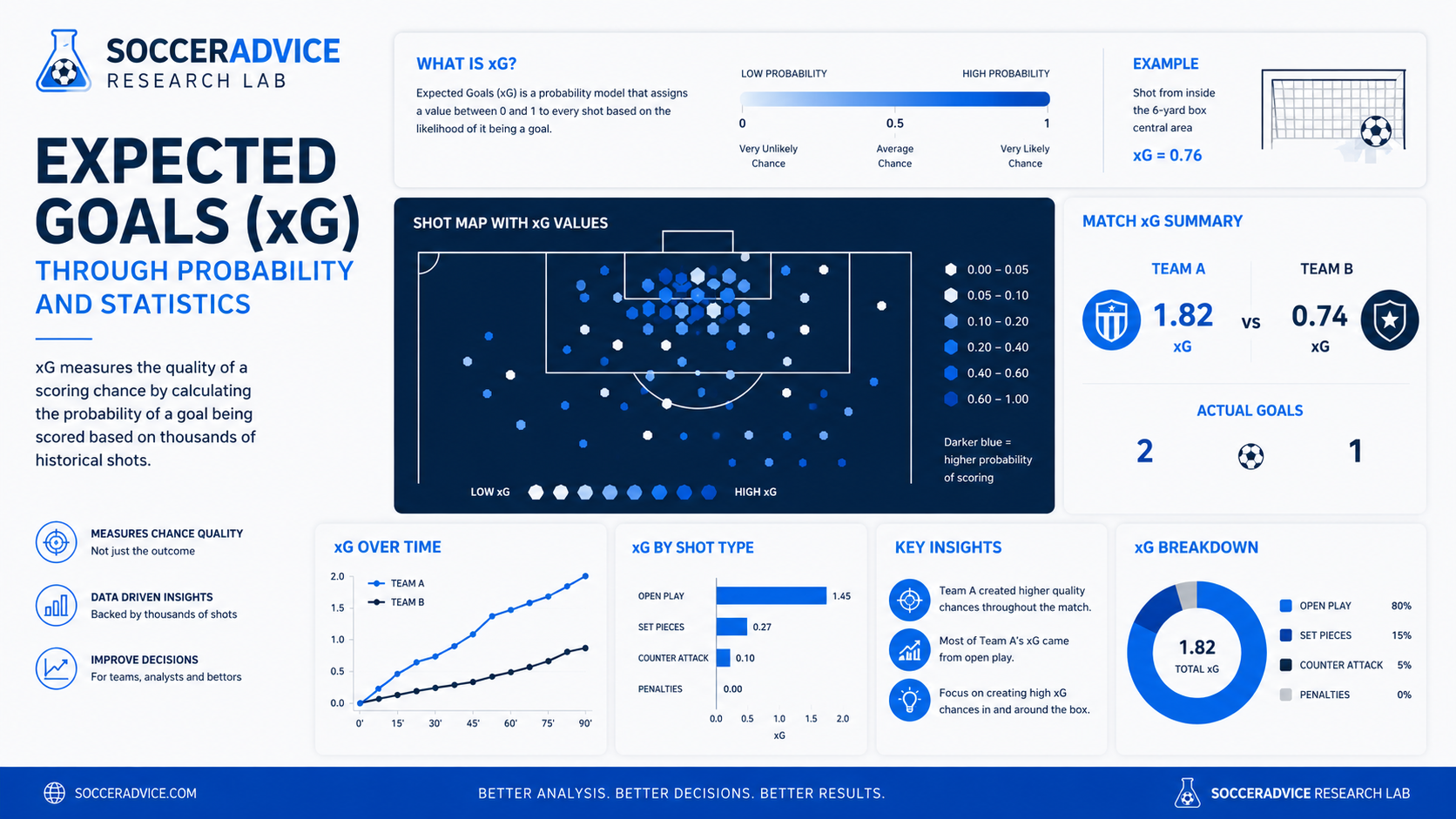
Expected Goals, usually written as xG, measures the quality of scoring chances. It is useful in football betting because it can show whether a team’s results are supported by chance creation or distorted by finishing luck.
xG does not tell you what will happen next. It gives you a better way to judge how dangerous a team’s chances were.
What Is Expected Goals (xG)?
xG assigns a value to every shot based on how often similar shots are usually scored. A shot with 0.30 xG means similar shots score roughly 30% of the time.
A penalty is usually around 0.75 to 0.80 xG because penalties are scored often. A long shot from 30 meters may be 0.02 xG because similar shots rarely go in.
Why xG Matters for Football Bettors
xG matters because final scores can be misleading. A team might win 2-0 from two low-quality shots, while another team might lose despite creating several strong chances.
For betting, xG can help you judge whether a team is creating repeatable attacking threat or simply benefiting from unusual finishing.
How xG Is Calculated
Shot quality
xG models look at shot location, angle, distance, body part, assist type, defensive pressure, and whether the shot is a big chance. Better locations and cleaner chances receive higher xG values.
Team xG totals
A team’s total xG is the sum of its shot values. If a team has shots worth 0.10, 0.25, 0.30, and 0.15, its total xG is 0.80.
Finishing versus chance creation
If a team scores 3 goals from 0.7 xG, it may have finished unusually well. If a team scores 0 from 2.1 xG, it may have created enough chances but failed to convert.
Strengths of xG
xG is stronger than shot count because not all shots are equal. Five weak long shots are usually less valuable than two close-range chances.
Expected Goals Examples
Shot xG = 0.30. This means similar shots score roughly 30% of the time. It does not mean the player had a 30% personal chance in that exact moment, but it gives a strong estimate based on similar historical shots.
A team wins 1-0 but loses the xG battle 0.4 to 1.8. The score says they won, but the chance quality suggests the opponent created better opportunities.
A striker scores 5 goals from 2.0 xG over a short run. That may show excellent finishing, but it can also suggest the scoring rate is unlikely to continue at the same pace.
Common xG Mistakes
- Treating xG as a prediction instead of a chance-quality measure.
- Ignoring team style and tactical context.
- Using one match of xG as proof of a long-term trend.
- Assuming every provider calculates xG the same way.
- Forgetting that finishing skill and goalkeeper quality still matter.
Practical xG Takeaways
- xG measures chance quality, not guaranteed goals.
- A shot worth 0.30 xG is scored by similar shots about 30% of the time.
- xG can reveal when a scoreline is misleading.
- Team xG trends are more useful than one match in isolation.
- Use xG with context, not as a standalone answer.
FAQ
What does xG mean?
Expected Goals measures how likely a shot is to become a goal based on similar shots.
Is xG useful for betting?
Yes, especially for judging chance quality, team performance, and whether results may be misleading.
Does 0.30 xG mean a 30% chance?
It means similar shots are scored roughly 30% of the time.
Can xG predict the next match?
Not directly. It helps describe performance, but future matches still depend on context.
What is the main weakness of xG?
It can miss context that is difficult to model, and different data providers may calculate it differently.
Conclusion
xG is one of the most useful football data concepts because it looks beyond the scoreline. It helps you judge chance quality, finishing variance, and whether a team’s results match its underlying performance.