
What Is Expected Points (xPts)?
What Is Expected Points (xPts)? Introduction Expected Points (xPts) is one of the most useful metrics in modern football analytics. Instead of looking only at the league table,.
Introduction
Expected Points (xPts) is one of the most useful metrics in modern football analytics. Instead of looking only at the league table, xPts estimates how many points a team would be expected to earn based on the quality of its performances.
A team can collect more points than its performances deserve through excellent finishing, goalkeeping, or luck. Likewise, another team may play well but earn fewer points than expected because of poor finishing or unfortunate results. Expected Points helps identify those differences.
What Is Expected Points (xPts)?
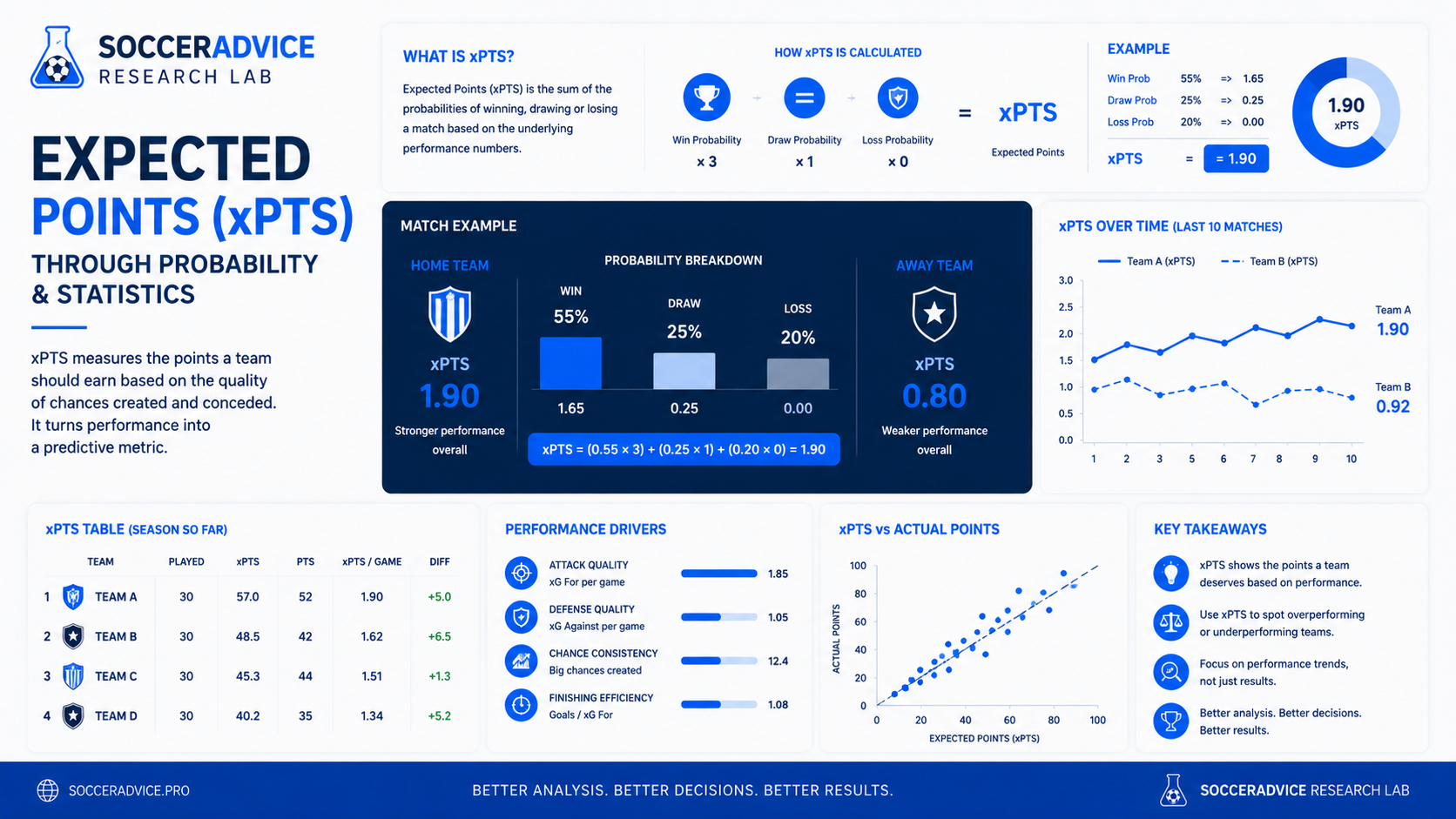
Expected Points (xPts) estimates how many league points a team should have based on the chances created and conceded throughout a season. Most xPts models are built using Expected Goals (xG)Expected Goals (xG), converting the probability of winning, drawing, or losing each match into an expected points total.
Unlike the actual league table, xPts focuses on underlying performance rather than final scorelines.
Why Expected Points (xPts) Matters
League tables do not always tell the full story. Teams can outperform or underperform their underlying statistics over short periods because football contains a significant amount of randomness.
xPts helps analysts identify teams that may be overachieving or underachieving, making it a valuable tool for evaluating long-term performance instead of relying only on recent results.
How Expected Points (xPts) Works
From Expected Goals to Expected Points
Most xPts models begin with Expected Goals (xG). Using the quality of chances created and conceded, statistical models estimate the probability of every possible match outcome.
Calculating Match Probabilities
If a team has a 60% chance of winning, a 25% chance of drawing, and a 15% chance of losing, those probabilities can be converted into expected points.
The formula is:
xPts = (Win Probability × 3) + (Draw Probability × 1)
Season Totals
Adding the expected points from every match produces a season-long xPts total, allowing analysts to compare actual points with underlying performance.
Expected Points (xPts) Examples
Example 1:
A team has collected 58 league points but its xPts total is only 48. This suggests the team may have benefited from clinical finishing, outstanding goalkeeping, or favorable variance.
Example 2:
Another team has earned only 39 points despite an xPts value of 49. Although results have been disappointing, its performances indicate it has played much better than the league table suggests.
Example 3:
A club consistently wins matches despite creating fewer quality chances than its opponents. Over time, analysts may expect those results to become harder to sustain.
Common Expected Points (xPts) Mistakes
- Confusing xPts with actual league points.
- Assuming xPts predicts future results with certainty.
- Ignoring injuries, tactical changes, and squad quality.
- Using one match instead of long-term trends.
- Comparing xPts from different data providers without understanding their methodology.
Practical Expected Points (xPts) Takeaways
- xPts measures underlying team performance rather than actual results.
- It helps identify overperforming and underperforming teams.
- xPts is most valuable over many matches, not a single game.
- Combining xPts with xG provides a deeper understanding of team strength.
- xPts should support football analysis, not replace it.
FAQ
What does Expected Points (xPts) mean?
Expected Points estimates how many points a team deserved based on the quality of its performances rather than actual results.
How is xPts calculated?
Most models use Expected Goals (xG) to estimate the probability of winning, drawing, and losing each match before converting those probabilities into expected points.
Why is xPts useful?
It helps reveal whether a team’s league position accurately reflects its performances or whether luck has played a significant role.
Can xPts predict future results?
No. It measures underlying performance, but football remains unpredictable and many other factors influence future matches.
What is the biggest limitation of xPts?
xPts is a model, not a fact. Different providers use different methodologies, so values can vary slightly.
Conclusion
Expected Points (xPts) looks beyond the league table to evaluate how teams have actually performed. By combining expected goals with probability models, xPts helps analysts identify whether results reflect performance or whether a team’s position may be influenced by finishing, goalkeeping, or variance. Used alongside other football analytics metrics, xPts provides a more complete picture of team strength.